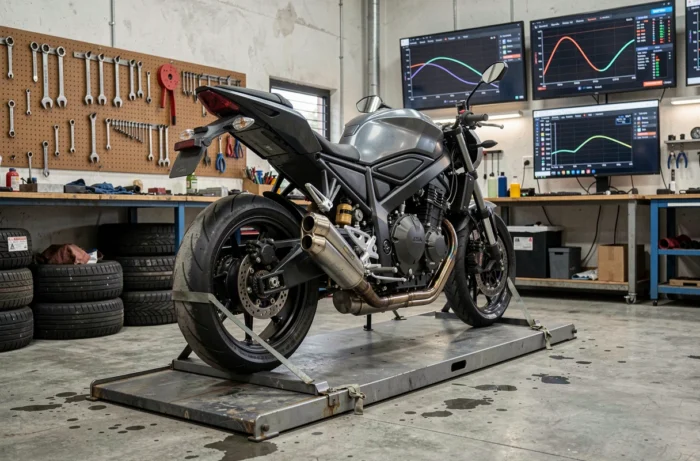
A motorcycle dyno test involves measuring the actual power and torque delivered to the rear wheel on a dynamometer. This measurement allows for comparing the engine’s actual performance to manufacturer data, detecting mechanical malfunctions, or validating modifications. The price varies depending on the type of service, the region, and the chosen provider.
Roller dyno and inertial dyno: what each type measures
Not all dynamometers operate in the same way, and the type of dyno used directly influences the reliability of the results. Two main types coexist in motorcycle workshops.
The brake roller dyno (or load dyno) applies a controlled resistance on the roller while the motorcycle accelerates. It replicates road conditions and measures power, torque, and RPM in real-time. This is the most common type among professional tuners.
The inertial dyno, which is simpler, calculates power based on the acceleration of a roller with a known mass. Less expensive to operate, it provides useful relative values for comparing a “before/after” on the same machine, but its absolute figures are less precise than those from a brake dyno.
Before booking, asking what type of dyno is used allows for proper interpretation of the results. A difference of a few horsepower between two different dynos does not necessarily indicate an engine problem: it is often the measurement method that differs. As specified in the detailed article on Miss Deux Roues, measurement conditions (ambient temperature, atmospheric pressure, condition of the rear tire) also affect the final result.
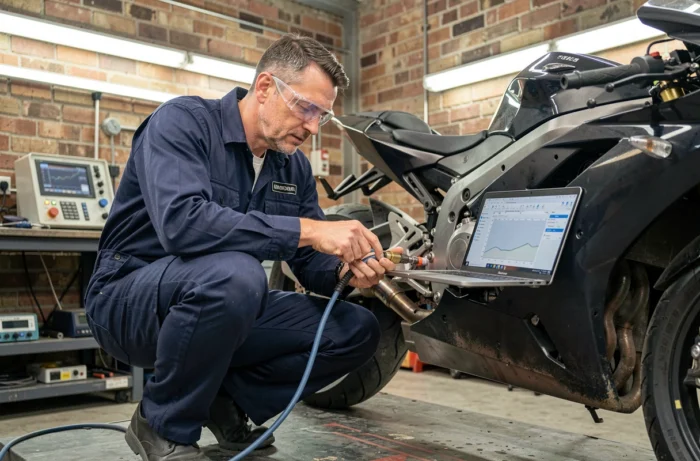
Cost of a motorcycle dyno test: observed price ranges
The “dry” dyno test without reprogramming is usually priced between 49 and 150 euros including tax. The variations can be explained by several concrete factors.
- In large urban areas, the service can reach 100 to 150 euros due to the higher operating costs of the premises and equipment.
- Group rates significantly reduce the bill. These “dyno day” events are regularly organized by clubs or forums of enthusiasts, allowing for shared costs of mobilizing the dyno.
A dyno test coupled with engine reprogramming raises the price into a whole different category. The cost then depends on the complexity of the mapping and the time spent by the tuner adjusting the parameters.
What is included (or not) in the displayed price
The base price generally covers the installation of the motorcycle on the roller, two to three “pulls” (RPM increases), and the delivery of a power and torque curve. Some providers charge extra for additional pulls or the printing of a detailed report.
Consumables are not trivial: a worn or under-inflated rear tire may be refused for safety reasons. It is better to check the condition of the tire before going, or risk losing the appointment.
Motorcycle technical inspection and power dyno: an evolving use
Since April 15, 2024, technical inspection is mandatory for motorized two-wheelers in France. This regulation changes how the power dyno is used.
The motorcycle technical inspection checks the noise level and, for mopeds, a speed check on the dyno (speedometer) must be implemented by 2026. For larger motorcycles, the dyno is not yet part of the CT protocol, but it is becoming a valuable preventive tool.
Owners of modified machines (exhaust system, reprogramming, transmission change) have every interest in checking their motorcycle’s compliance on the dyno before the CT. An unapproved sports exhaust that exceeds the noise threshold or an abnormal power for an A2 restriction will result in a refusal at the inspection. A dyno test beforehand allows for identifying the problem and correcting it before presenting at an authorized center.
A2 restriction and validation on the dyno
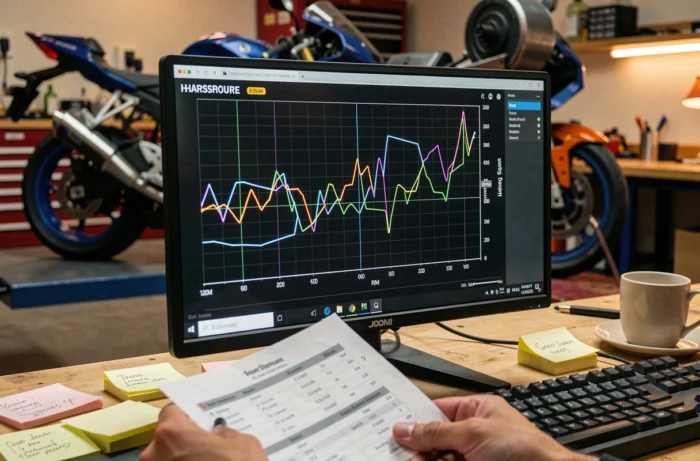
For A2 license holders, the dyno test serves to certify that the motorcycle is indeed restricted to 35 kW (47.5 hp). This test is often included in the installation package of the restriction kit by the professional. When charged separately, it represents a modest additional cost compared to the overall price of the restriction, labor, and updating the registration document.
Choosing a provider for a motorcycle dyno test
The quality of the measurement depends as much on the equipment as on the operator. A poorly calibrated dyno or an inexperienced technician can skew the results by several horsepower.
- Prefer a workshop equipped with a recognized brand brake dyno that is regularly calibrated.
- Check that the provider is experienced with motorcycles: some centers specialize in automobiles and only have a rarely used motorcycle adapter.
- Ask if the corrected power curve (adjusted to standard temperature and pressure conditions) is provided, as it alone allows for a reliable comparison with manufacturer data.
- Consult reviews on motorcycle forums and local groups: a tuner’s reputation is built on the repeatability of their measurements.
The dyno test remains an accessible technical service, the cost of which is justified by the reliability of the diagnosis obtained. Whether the process aims for a simple engine health check, validation of a modification, or preparation for the technical inspection, the choice of provider weighs as much as the displayed price on the relevance of the result.