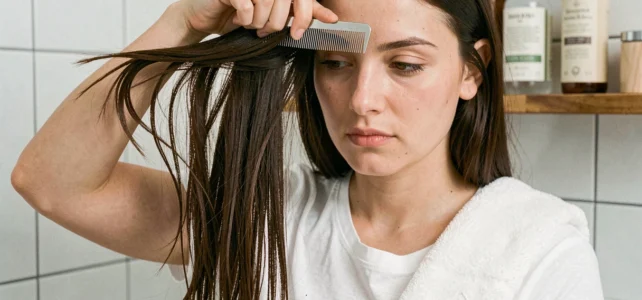
Itchy scalp, small red spots on the nape, and a pet scratching next to you on the couch. The connection is quickly made: fleas may have found their way into your hair. The good news is that fleas almost never settle permanently on a human head. The bad news is that as long as the source of the infestation persists, the bites will return.
Fleas in the hair: why they don’t stay but keep coming back
You may have noticed that an infested cat or dog scratches constantly, while you only experience occasional bites? The reason is simple. The cat flea (Ctenocephalides felis), by far the most common in France, is adapted to the dense fur of warm-blooded animals. The human hair is too smooth and too spaced out for it to cling on for long.
The only species that actually targets humans is called Pulex irritans. It can bite at the scalp, but clinical studies show that it mainly resides in the seams of clothing and bedding, not in the hair itself. This detail changes everything for the elimination strategy.
Before multiplying shampoos or essential oils, it is essential to identify the real target. To get rid of fleas in the hair, treating the scalp alone is not enough if clothing, sheets, and seats remain infested.
Confirming the presence of fleas before treating the scalp
Dermatologists and pediatricians emphasize a often overlooked point: not every itch of the scalp is necessarily caused by fleas. Lice, mites, folliculitis, seborrheic dermatitis can cause very similar symptoms.
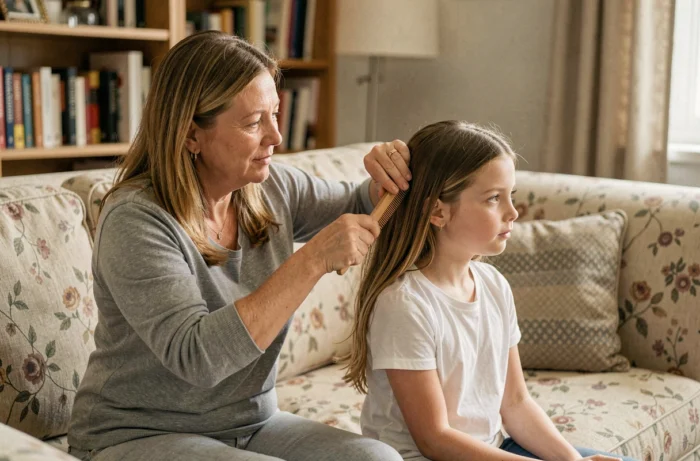
The recommended method is an examination under good light with a fine-toothed comb, the same one used for lice. What you are looking for is the insect itself (small, brown, flattened laterally) or its droppings, tiny black dots that turn reddish when in contact with water.
Why is this step so useful? Because flea and lice treatments are not interchangeable. A classic pediculicide product will have no effect on fleas, and vice versa. Treating blindly multiplies chemical applications without results, which further irritates the scalp.
Flea treatment for the scalp: effective actions
Once the flea is confirmed, direct treatment of the head remains the simplest. Here are the concrete steps, in order of priority:
- Wash the hair with a mild shampoo, then use a fine comb strand by strand on wet hair. Fleas, unlike lice, do not cling tightly: they fall off easily in water.
- Apply a product based on dimethicone (non-toxic silicone that suffocates the insect by coating it), available at pharmacies. This type of treatment works mechanically, without chemical insecticides.
- Rinse thoroughly and repeat combing two to three days later to catch any potential survivors.
Methodical combing on wet hair remains the most effective action to physically remove fleas from the scalp. Shampoo alone, even flea shampoo, is not always enough to dislodge them if they are numerous.

Treating the home and pets: the key to lasting elimination
Treating the head without treating the environment is like draining a bathtub without turning off the tap. Fleas lay their eggs in textiles, carpets, cushions, and the pet’s bed. The larvae develop in the home, not on your scalp.
Textiles and bedding
Wash sheets, pillowcases, towels, and recently worn clothes at a temperature of at least 60 °C. High-heat drying enhances effectiveness. Non-washable items (decorative cushions, stuffed animals) can be isolated in a sealed plastic bag for several days or treated with a suitable insecticide for textiles.
Floors and furniture
Vacuum daily for at least two weeks, paying special attention to baseboards, floor gaps, and under furniture. Empty or throw away the vacuum bag after each use to prevent larvae from continuing their cycle inside the device.
For significant infestations, an insecticide treatment of the home (spray or fogger containing an insect growth regulator) targets eggs and larvae. These products are available at pet stores or pharmacies. Follow the ventilation times indicated on the packaging.
Pets
The pet is almost always the initial source of the infestation. An appropriate flea treatment (spot-on, tablet, or collar as recommended by the veterinarian) must be applied in parallel. Without this, reinfestation of the home and scalp is almost certain within a few days.
Common mistakes that prolong flea infestations
Some reflexes seem logical but slow down elimination:
- Only treating the head while forgetting clothing and bedding. Visible adult fleas represent only a small fraction of the total population: eggs, larvae, and pupae live in the environment.
- Using lice shampoo against fleas. The formulations do not target the same parasite, and the result will be disappointing.
- Stopping vacuuming after three days. The flea cycle lasts several weeks. Pupae can remain dormant and hatch well after the first treatment.
- Multiplying essential oils without checking their proven effectiveness. Some (like lavandin) have a slight repellent effect, but none replace a mechanical or insecticidal treatment on a declared infestation.
The persistence of a flea infestation is rarely due to a bad product. It almost always comes from incomplete treatment of the environment. A clean scalp in an still infested home will be bitten again the next day. By combining methodical combing, high-temperature washing, and simultaneous treatment of the pet, most infestations can be resolved in two to three weeks.