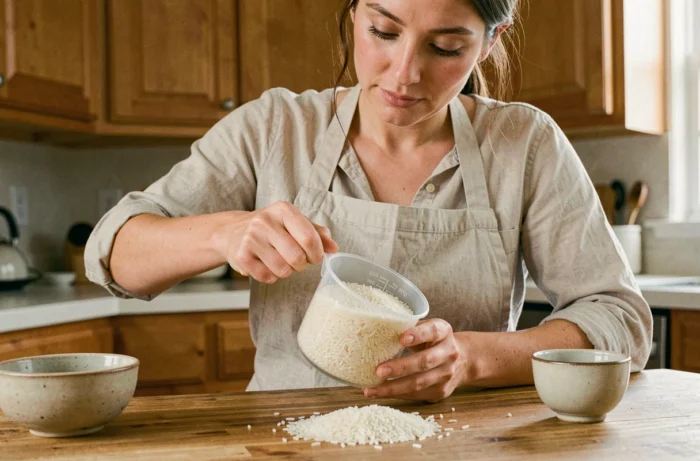
The expansion coefficient of rice varies according to the variety, grain size, and cooking method. Without mastering this parameter, any measurement in grams of uncooked rice remains approximate. We start from this point to establish a reliable method, applicable to any recipe.
Rice expansion coefficient: the variable that standard measurements ignore
A long grain rice (basmati, Thai) absorbs less water than a round grain rice (arborio, sushi rice). The final volume after cooking therefore differs significantly from one variety to another, even for the same starting weight.
Basmati rice expands by about a factor of 2.5 to 3 in volume. Round rice intended for risotto or sushi easily reaches a factor of 3 to 3.5, because its starch content retains more water within the grain structure.
We recommend thinking in cooked rice weight rather than uncooked rice weight. The reason is simple: the portion you serve on the plate is cooked rice. Starting from the cooked eliminates the uncertainty related to expansion. For an adult side dish, aiming for between 150 and 200 g of cooked rice covers most appetites. You can then backtrack to the uncooked weight by dividing by the coefficient specific to your variety.
This approach aligns with the guidelines inspired by the National Nutrition Health Program (PNNS), which situate the portion of cooked starches between 50 and 100 g for a quarter of the plate when rice is accompanied by vegetables and proteins. The weight increases when rice is the main dish.
Measuring rice without a scale: glass, mug, and fist method
The scale remains the most reliable tool, but in everyday cooking, it is often set aside. Several everyday containers provide reproducible results, provided you know their equivalence in uncooked rice grains.
- A standard mustard glass (about 20 cl) contains roughly the amount of uncooked rice needed for two people as a side dish. This is the most common reference in home cooking.
- A classic mug (about 25 cl) covers three side portions. Useful when you are hosting or preparing a family dish.
- The closed fist method: an amount of uncooked rice equivalent to the volume of your fist roughly corresponds to an individual portion. Less precise, but sufficient for a daily meal.
Regardless of the container, the water/rice ratio determines the final texture. For basmati, we use a ratio of 1.5 volumes of water to 1 volume of rice. For round rice, the ratio increases to 2 volumes of water. These ratios assume covered cooking on low heat after boiling, with complete absorption.
You will find additional details on the subject by going read on Les Coudes sur la Table, particularly regarding portion adjustments according to guests.
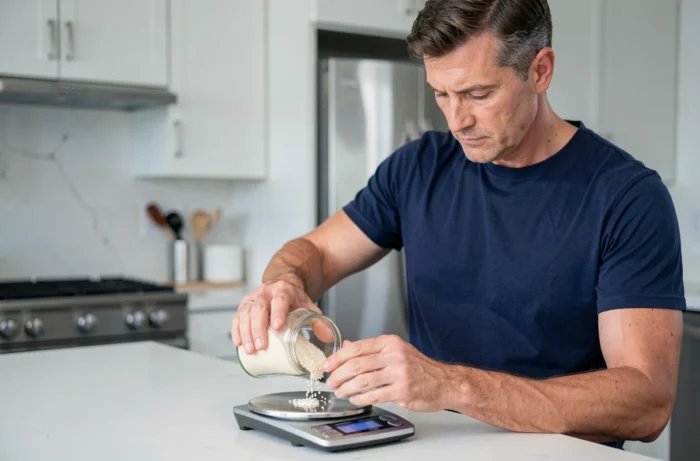
Rice quantity per person according to the type of dish
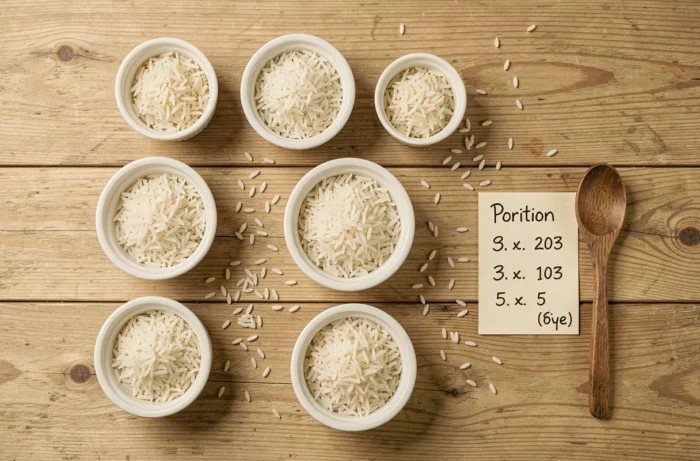
The measurement does not boil down to a single number. Rice served as a side to a well-stocked curry does not require the same volume as a risotto served as a main dish. We distinguish three scenarios.
Rice as a side to vegetables or proteins
This is the most common case. About 60 to 80 g of uncooked rice per person is sufficient. The rest of the plate is occupied by vegetables (ideally half) and the protein source (a quarter). This measurement corresponds to the quarter plate of starches recommended by French nutritional guidelines.
Rice as a main dish (risotto, fried rice, paella)
When rice is the star of the dish, the portion of uncooked rice increases. Count between 100 and 120 g per person. A risotto requires round rice with high absorption capacity, so the cooked volume will be substantial. A paella incorporates broth, seafood, and vegetables directly into the cooking, which concentrates flavors without necessitating an excessive increase in rice weight.
Rice for sushi and onigiri
Sushi rice is vinegared and compacted. Plan for about 80 to 90 g of uncooked rice per person for about ten pieces of maki or nigiri. The rice should be rinsed until the water runs clear, then cooked with a water/rice ratio close to 1:1, before being seasoned with rice vinegar.
Rice portions for children: progression by age group
Popular articles often refer to “half-child portion” without precision. Recent guidelines for children’s servings are more nuanced and distinguish age brackets.
At 5 years old, the portion of cooked starches is around 100 to 120 g, or about four tablespoons of cooked rice. This amount increases each year, reaching 160 to 180 g of cooked starches by around 9 years old.
Converting these guidelines into uncooked rice requires dividing by the expansion coefficient of the chosen variety. For basmati rice (approximately factor 2.5), 120 g of cooked rice corresponds to about 50 g of uncooked rice. This is a reliable starting point for adjustments over meals.
Cooking and water quantity: the direct link with measurement
A correct measurement of uncooked rice is useless if the amount of water is poorly calibrated. Too much water produces sticky rice that expands beyond its normal coefficient. Not enough water leaves a hard grain in the center.
The absorption method (covered, low heat, no draining) is the most suitable for home measurement. It allows for precise control of the volume of water absorbed by the grains. The finger test, often cited, involves placing the index finger on the leveled rice in the pot: the water should reach the first knuckle. This reference works correctly for quantities between two and four portions.
For larger volumes (beyond six people), the volumetric ratio becomes more reliable than the finger method, as the surface area of the pot alters the perceived water height.
Ultimately, the measurement of rice relies on three interrelated parameters: the variety (which determines expansion), the type of dish (which sets the uncooked weight per guest), and the water/rice ratio (which guarantees texture). Mastering these three axes makes every cooking predictable, without waste or insufficient portions.