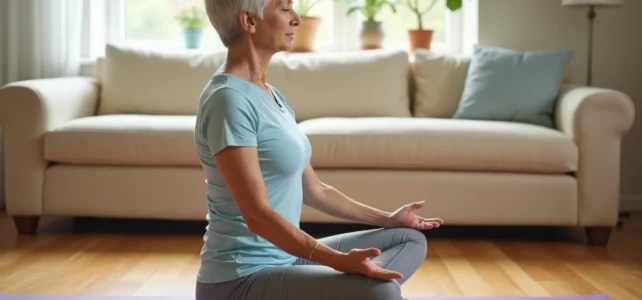
Strength training at home for seniors is not just about doing a few knee bends in front of the television. In practice, we observe that most online programs overlook two key parameters: the relative intensity of effort and the progression of loads, even without equipment. Adapting the exercises to the individual functional threshold radically changes the results in fall prevention and maintaining autonomy.
Load Threshold and Progression Without Equipment for Seniors
A strength training exercise only has an effect if it challenges the muscle beyond its daily activity level. For a sedentary senior, this threshold is low, which is an opportunity: simple movements are sufficient as long as the difficulty is gradually increased.
The WHO recommendations for those over 65 emphasize the practice of strength exercises at least twice a week, targeting the major muscle groups. The good news is that these exercises can be done without equipment, directly at home.
We recommend structuring the progression into three levels over the first few weeks:
- Level 1: assisted movements (squats while holding onto a chair, wall push-ups) with short sets and long breaks between each repetition.
- Level 2: the same movements without support, increasing the number of repetitions or slowing down the eccentric phase (the downward movement) to increase time under tension.
- Level 3: adding domestic resistance (water bottles, weighted backpack) and introducing unilateral movements (forward lunge, balance on one foot) that further engage proprioception.
This scheme helps avoid the adaptation plateau that we see in people who repeat the same circuit for months without any additional benefit. Exploring physical activities for seniors with Medic Com gives a good overview of exercises adaptable to this type of progression.
Tai Chi and Yoga at Home: Underestimated Balance Work
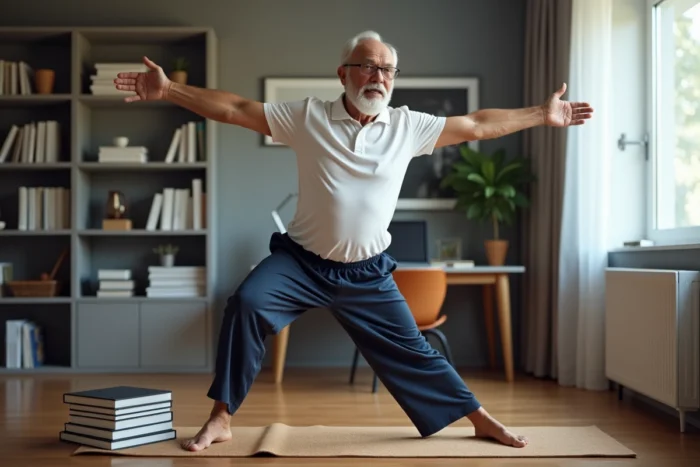
Tai Chi and yoga are often presented as gentle, almost recreational activities. This is a misjudgment. Tai Chi continuously engages postural stabilizers, making it one of the most effective tools against the risk of falls in seniors.
At home, practicing Tai Chi requires only a clear space of two square meters. The slow sequences impose permanent weight transfers between unipedal and bipedal support. This proprioceptive work is precisely what declines first with age.
Yoga, on the other hand, combines stretching and isometric strengthening. The held postures (chair, tree, modified warrior) develop both lower limb strength and joint flexibility. For a senior just starting out, seated postures or those with chair support provide a relevant entry point.
Frequency and Duration of Balance Sessions
We recommend Tai Chi or yoga sessions lasting ten to fifteen minutes, three to four times a week, rather than one long weekly session. Consistency is more important than duration. Short, frequent sessions improve postural balance faster than spaced-out practices, even if longer.
A technical point often overlooked: practicing barefoot on a stable surface (not on overly soft mats) improves plantar sensory feedback, which enhances postural adjustment reflexes.
Adapted Cardio Exercises Without Joint Impact
Cardio at home for a senior does not involve burpees or jump rope. Two formats stand out for their accessibility and effectiveness.
Marching in place with knee lifts remains the foundation of home cardiovascular work. Performed facing a countertop or chair back (for safety), it can be modulated in intensity simply by varying the height of knee lifts and the pace.
The second format we favor is low-impact circuits: chaining standing movements (side steps, slow butt kicks, torso rotations with arms) for blocks of two to three minutes, interspersed with active breaks (slow walking, deep breathing). This format keeps the heart rate in a moderate zone without spiking joint pressure.
Diaphragmatic Breathing and Active Recovery
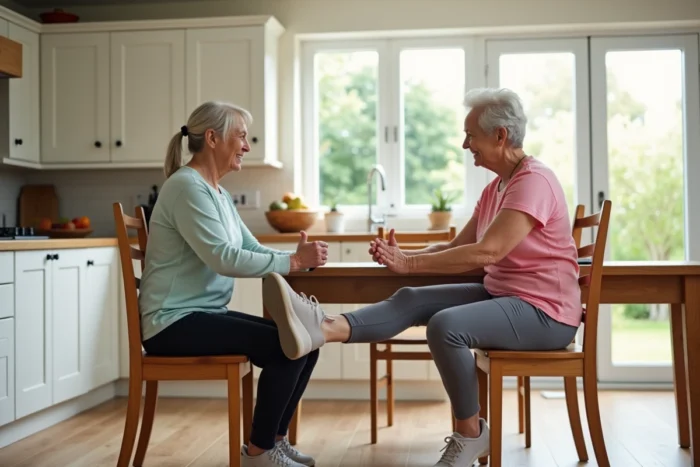
Diaphragmatic breathing is not just a simple relaxation exercise. Practiced while sitting or lying down, it engages the diaphragm and intercostal muscles. For seniors whose lung capacity is decreasing, this breathing work complements cardio sessions effectively.
Three to five minutes of abdominal breathing at the end of a session gradually lowers heart rate and promotes muscle recovery.
Exercise on Prescription and Home Supervision
The exercise on prescription scheme now allows doctors to prescribe adapted physical activity sessions, including at home, for seniors with chronic conditions (diabetes, cardiovascular diseases, cancer, obesity). Sports-health centers experimenting with this model have observed a significant increase in adherence among those over 65 when exercises can be performed at home.
This prescription opens the door to follow-up by a qualified instructor in adapted physical activity who tailors exercises to the patient’s functional limitations. The difference with a generic program found online is considerable: each movement is calibrated according to the person’s joint, cardiac, and cognitive status.
- Ask your primary care physician if you qualify for the exercise on prescription scheme before starting an independent program.
- Check for the presence of a sports-health center in your municipality or department to benefit from an initial functional assessment.
- Prefer regular follow-up (even remotely) rather than a fixed program, to adjust the difficulty every three to four weeks.
Home physical activity for seniors becomes more effective when it is based on a logic of individualized progression. An adapted and regularly adjusted program protects better than a high volume of poorly calibrated exercise. The first reflex remains to consult your doctor, especially in the presence of chronic conditions, to transform daily exercise into a true health lever.