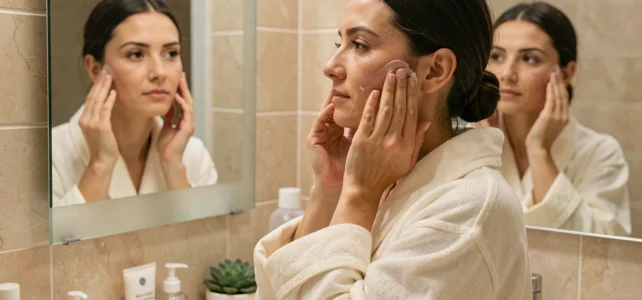
Your skin feels tight at the end of the day, your hair lacks shine, and your complexion looks dull despite hastily applied cream. Enhancing your beauty daily doesn’t rely on piling up products, but on a few precise gestures, repeated consistently. The challenge lies as much in the choice of treatments as in less visible habits, like reading a label or protecting against screens.
Blue light and skin: an underestimated aging factor
You spend several hours a day in front of a phone or computer screen. This prolonged exposure to artificial blue light affects skin quality. Research reported by EMJ Reviews has established a link between screen time and a degraded perception of skin and body image.
Specifically, blue light promotes oxidative stress in skin cells. This phenomenon accelerates the appearance of pigmentation spots and alters the glow of the face. An antioxidant treatment applied in the morning limits this damage. Look for active ingredients like stabilized vitamin C or vitamin E in the INCI list, which neutralize free radicals generated by screens.
The simplest reflex is to reduce the brightness of your devices and activate the blue light filter by late afternoon. This gesture also protects sleep quality, which plays a direct role in skin regeneration during the night.
To explore routines suitable for each skin type, resources are available on the entire Mes Secrets de Beauté website, which covers facial care as well as hair and makeup.
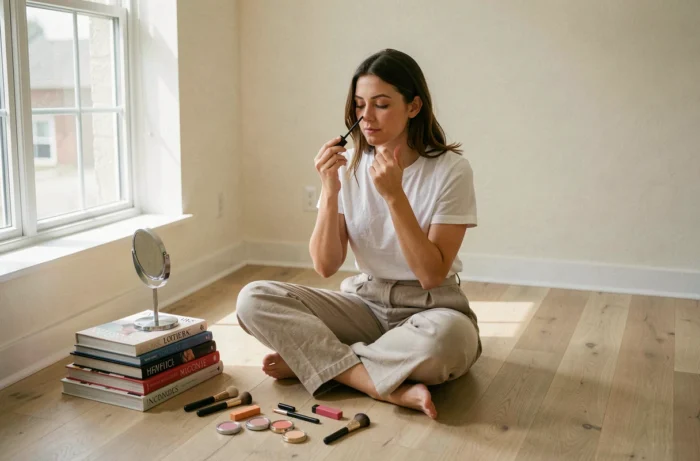
Facial beauty routine: three gestures are enough
The most common mistake is layering too many products. A serum, a day cream, an eye cream, an oil, a primer: the skin ends up saturated. The result is the opposite of the desired effect, with clogged pores and a muddled complexion.
Clean without stripping
Facial cleansing, morning and evening, is essential. In the evening, it removes makeup residue, pollution, and accumulated sebum. In the morning, a light cleanse is enough to remove toxins expelled overnight. A gentle cleanser, free from harsh sulfates, preserves the hydrolipidic film.
Have you noticed that your skin feels tight after cleansing? This is a sign that the product used is too stripping. Switch to a soap-free formula or a micellar water suitable for your skin type.
Moisturize according to the season
A moisturizer has a different texture in winter and summer. Adjust the texture of your cream to the season and your sebum level. In summer, a light gel or fluid is sufficient. In winter, a richer cream compensates for dehydration caused by heating and cold.
Protect from the sun, even in the city
Sun protection is the most effective and overlooked anti-aging gesture. UVA rays penetrate clouds and windows. A sunscreen applied every morning protects against spots and premature aging. Choose an appropriate SPF and reapply if you spend time outdoors.
Reading cosmetic labels: what changes with European regulation
A bottle of cream or serum carries a list of ingredients called the INCI list. Most consumers skim over it without understanding it. Since Regulation (EU) 2023/1545, this list will become much longer on many products.
The reason: the number of fragrance allergens that must be declared on cosmetics sold in the European Union has increased from about 24 to over 80 substances. This requirement applies to new products launched on the market from July 31, 2026. Products already on the shelves have a sales deadline until July 31, 2028.
This also affects so-called “natural” products. A facial treatment based on vegetable oils may naturally contain fragrance allergens (linalool, limonene, geraniol). A “natural” product is not necessarily allergen-free. Check the end of the INCI list, where allergens are now detailed.
Another point to watch for: the mention “This product contains microplastics.” Under the REACH restriction, cosmetics containing intentionally added microplastics must display this information. Some shower gels or exfoliating creams are affected.

Hair and makeup: mistakes that dull the result
<pEnhancing your beauty also involves hair and makeup, but some common habits produce the opposite effect.
- Washing your hair every day with a regular shampoo stimulates sebum production. Spacing washes to two or three times a week allows the scalp time to regulate its natural production.
- Applying foundation on poorly hydrated skin creates a caked effect. First hydrate, wait two minutes, then apply makeup for a blended and natural finish.
- Using metal hair accessories on wet hair breaks the hair fiber. Opt for a wide-toothed comb or a flexible detangling brush.
Enhancing makeup relies on skin preparation. A well-hydrated and protected complexion gives a glow that even the best highlighter cannot replicate.
Self-confidence and beauty: a concrete link, not a slogan
Research reported by EMJ Reviews highlights that time spent on social media influences the perception of one’s own body image. Comparing your face to retouched photos undermines self-confidence, which even alters posture and facial expressions.
Reducing screen time on social media improves the perception of one’s own skin. This is not personal development advice; it’s a measured observation. Less comparison leads to less stress, and less stress reflects on complexion, sleep quality, and more reasonable skincare choices.
Enhancing your beauty daily ultimately comes down to simple yet precise gestures: cleanse, hydrate, protect, read what your products contain, and give your skin the calm it needs to regenerate. The coming months, with the implementation of the new European labeling, will empower every consumer to make more informed choices in the cosmetic aisle.