
With over 211,000 recorded home burglaries in France in 2025 according to the SSMSI, the question of protecting valuable items at home remains very real. A burglar spends an average of a few minutes in a home and targets predictable places: bedroom, closet, nightstand. The principle that works is to distribute your valuable items in several discreet hiding spots rather than concentrating everything in one place.
1. Fake cleaning product in the kitchen cupboard
We start with the room that burglars inspect the least: the kitchen. A can of food, a bottle of cleaner, or a double-bottomed sauce jar can be slipped among the real products without attracting attention. These double-bottom containers can be found commercially, but you can also recycle an emptied and weighted packaging.
The strong point is the volume of products around. A burglar is not going to open thirty cans. However, this hiding spot is only suitable for small items: jewelry, USB drive, cash. If you’re looking for more ideas for secret home hiding spots, the same food camouflage principle can be applied with jars, cereal boxes, or fake milk cartons.
2. Technical duct behind an access hatch
Every home has technical hatches: under the bathtub, above the water heater, behind the electrical panel. These spaces are rarely searched because they don’t look like storage areas. You can attach a small waterproof box with Velcro or magnets there.
Be cautious of humidity in certain ducts, especially in the bathroom. A zip bag with silica gel protects documents or jewelry. Access requires a tool (screwdriver, square key), which adds an extra barrier.
3. Wall photo frame with a back compartment
A medium-sized frame mounted on the wall can conceal a flat space between the back of the frame and the wall. You can slip cash, backup bank cards, or a small bag of jewelry inside. The frame should be screwed in (not just hung) so that removal requires a deliberate action.
This hiding spot works even better when you multiply frames on a wall. Three or four frames side by side, with only one hiding something: the burglar won’t take them all down.
4. Fake electrical outlet with a double bottom
This is one of the most discreet hiding spots. A fake wall outlet, installed next to real outlets, opens with a rotation or pressure mechanism. The interior space is limited, but sufficient for a USB drive, a ring, or a small roll of cash.
Installation requires cutting the drywall if working with plasterboard. On a load-bearing wall made of concrete block or brick, it’s more complex. Feedback varies on the ease of installation depending on the type of wall, but on standard drywall, you can manage it in an hour with a hole saw.
5. Double bottom under a furniture drawer
The drawer itself is searched, but the space under the drawer is almost always ignored. You attach a thin board (3 mm plywood, plexiglass) under the bottom of the drawer with small side battens. The item is wedged between the real bottom and the added board.
To keep the hiding spot invisible, the drawer must slide normally. Choose a deep drawer whose slide can tolerate slight extra weight. A dresser drawer in a child’s room or an entryway furniture works well.
6. Weighted flower pot in the garden or on the balcony
A large terracotta or resin flower pot, with a real plant on top, can contain a waterproof tube buried in the potting soil. Use a PVC tube with a screwed cap, pushed vertically under the root ball.
This solution is suitable for items that can withstand residual moisture: gold coins, safe keys, metal jewelry. Paper documents require a perfectly airtight container. The big advantage: no one will turn over a 20 kg flower pot during a burglary.
7. Magnetic box under a metal piece of furniture
A flat magnetic box can be fixed under a metal desk, refrigerator, washing machine, or workbench. The item is invisible without getting on all fours and sliding your hand under the appliance.
A few precautions to follow:
- Check that the magnet holds firmly on the surface (some appliances have a coating that reduces adhesion)
- Avoid storing magnetic cards or hard drives in direct proximity to the magnet
- Regularly clean to prevent dust from revealing the presence of the box on the floor
8. Hollowed-out book in a filled bookshelf
A classic, but it works under one condition: the bookshelf must contain at least several dozen books. A hollowed-out book among five works can be spotted immediately. Among two hundred, it disappears.
Choose a boring title, not a beautiful collectible book that attracts the eye. A technical manual, an old dictionary, or a thick paperback will do the trick. The hollowed-out content can hold jewelry, cash, or small documents.
9. Fake PVC pipe in the garage or basement
A piece of standard diameter PVC pipe (50 or 100 mm), cut to the right length, closed with two caps, and fixed to the wall among other pipes. In a garage or basement where several pipes already run, an additional section raises no questions.
Points to check:
- Use fastening collars identical to those already in place so that the pipe seems part of the installation
- Avoid positioning it at eye level, prefer a high passage near the ceiling
- Discreetly mark the right pipe (a paint dot, a notch) for easy retrieval
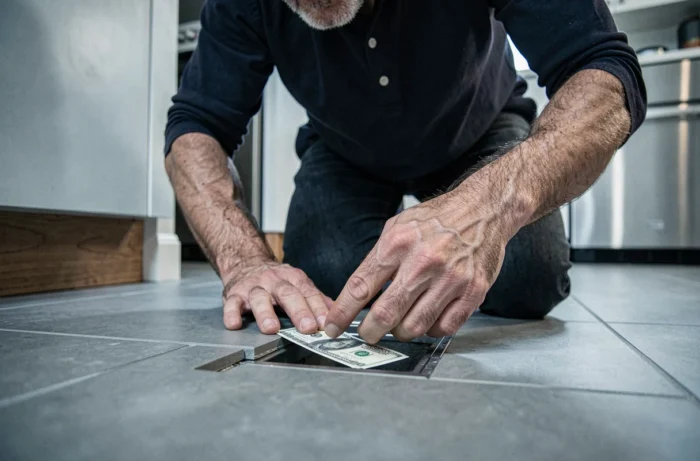
10. Compartment under a floating floorboard
With a clipped floating floor, removing one or two boards to access the space underneath takes less than a minute. Create a flat space by placing the item in a zip bag, then reclip the boards. The surface remains identical to the rest of the floor.
This method works best in a little-frequented room (office, guest room) to limit localized wear that could signal manipulation. On glued or nailed flooring, the operation is significantly heavier and leaves traces.
The key data to keep in mind: nearly 40% of recent burglaries occur while the occupants are present, according to GMF. This means that the hiding spot must withstand not only a quick search but also a stressful situation where one cannot retrieve their belongings. Diversifying locations remains the best strategy, because a burglar who finds one hiding spot may not necessarily look for the other nine.