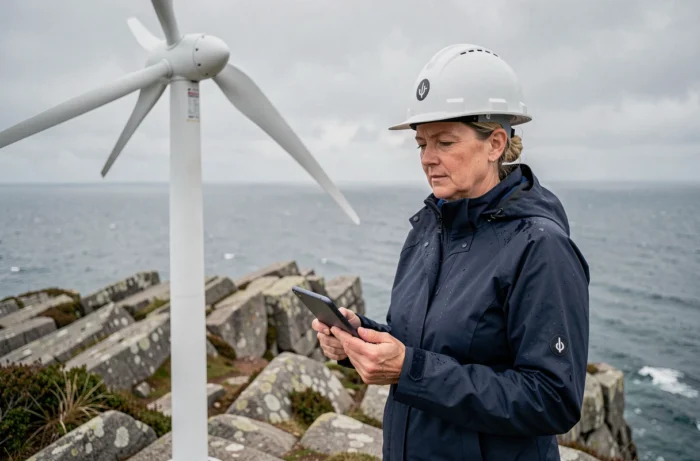
Brittany still produces a minority share of the electricity it consumes. This structural constraint, linked to the absence of a nuclear power plant in its territory, has driven the region to multiply energy demonstrators at a pace that few French regions can match. Over the past few years, we have observed an acceleration along three specific axes: storage coupled with island solar, floating offshore wind, and territorial decarbonization led by private industrial actors.
Battery Storage and Collective Self-Consumption in Breton Island Environments
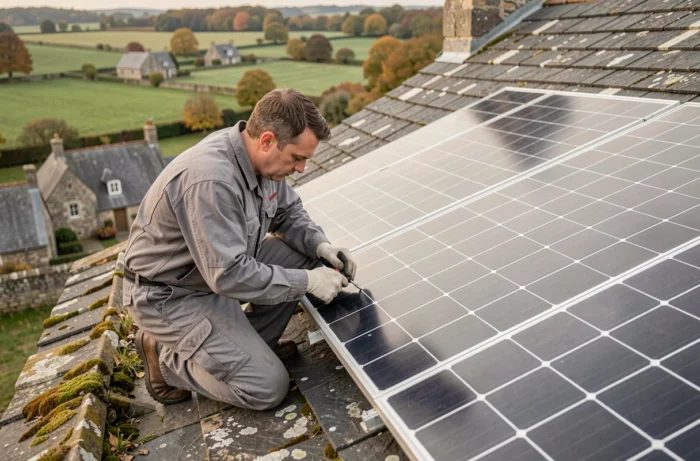
The island of Houat, in Morbihan, serves as a rarely documented case study in general articles about energy transition. Morbihan Énergies inaugurated a photovoltaic power plant of 500 kWc coupled with 900 kWh of storage in September 2026, with the launch of collective self-consumption scheduled for October 1, 2026.
The chosen sizing is not trivial. On a non-interconnected island, the storage/production ratio (approximately 1.8 kWh of battery per kWc installed) reflects a desire to cover nighttime consumption peaks without resorting to the existing diesel generator. The stated goal: to provide local electricity at controlled prices to households participating in the scheme.
This model goes beyond a simple technical demonstrator. It tests the economic viability of collective self-consumption in a context where the marginal cost of fossil production on the island remains among the highest in France. Feedback from Houat will directly inform similar projects planned on other Breton islands.
The Breton actors structuring these sectors are listed on the breizhpowerfr website in Brittany, which facilitates the identification of local project leaders in storage and solar energy.
Brest Port and Floating Wind: Industrial Logistics and Financing
Floating wind in Northern Brittany is no longer a prospective topic. The port of Brest has been confirmed as an assembly site and benefits from 58 million euros for floating wind, as part of a national envelope of 260 million euros distributed across five French ports.
We recommend distinguishing two issues often confused in the regional press:
- The logistical capacity of the port (draft, storage area for floats, lifting capacity) conditions the number of machines that can be assembled per year and thus the profitability of the site
- The regulatory timeline for priority zones identified in Northern Brittany for offshore wind by 2035 sets the pace for calls for tenders, regardless of the industrial maturity of the port
- The structuring of a local maintenance sector, which requires skills in underwater welding, inspection of dynamic cables, and offshore logistics, remains the weak link in the Breton system
The main risk lies in the time lag between the port investments already made and the actual awarding of the first parks. A delay of two to three years on the calls for tenders could weaken the Breton subcontractors who have sized their workforce based on an optimistic timeline.
Territorial Decarbonization Led by an Industrial Actor: The Case of La Gacilly
The Rocher group has conducted a project called “La Gacilly, a low-carbon territory” from 2021 to the end of 2025. The uniqueness: no reliance on carbon compensation. The goal was to directly reduce emissions within the municipal perimeter, involving the community, residents, and the group’s industrial sites.
This model reverses the usual logic where the local community solely carries the climate strategy. Here, a private actor with financial resources and internal engineering has led the energy transformation of a rural territory. The activated levers cover energy efficiency of buildings, employee mobility, and procurement of local renewable energy.
For Brittany, this type of experimentation presents a direct methodological interest. The region has several intermediate-sized industrial basins (agri-food, cosmetics, naval) where a dominant employer could play this role of territorial locomotive.

Green Hydrogen and Educational Platforms: Real Maturity of Breton Projects
Lhyfe, a company listed on Euronext and present in Brittany, continues its development in green hydrogen production. The company is structuring decentralized production projects that directly interest the bus and garbage truck fleets of Breton municipalities.
On the training side, the IUT of Lorient has deployed educational platforms dedicated to solar energy, aimed at training technicians who will work on the photovoltaic installations in the territory. This point is rarely addressed, but the availability of qualified labor constitutes a real bottleneck for the deployment of renewable energy projects in Brittany.
The convergence between hydrogen production, battery storage, and solar creates a technical ecosystem that requires hybrid profiles, both electricians, thermal engineers, and trained in digital control systems. Breton companies recruiting in this field struggle to find these skills.
Energy Digitalization and Smart Grids in Brittany
The SMILE project, led by the Brittany Region, has laid the groundwork for a shared energy data infrastructure. Lorient Agglomeration has contributed through its Territorial Digital Scheme, coupling management of digital networks and energy optimization of public buildings.
The digitalization of the Breton energy sector is not limited to smart metering. It includes predictive demand management on island micro-grids like Houat, real-time control of charging stations for electric vehicles, and aggregation of data from decentralized solar production.
The challenge for the coming years remains the interoperability of platforms. Each agglomeration, each energy union develops its own tools. Without a shared regional standard, efficiency gains will remain confined to narrow perimeters, far from the territorial scale necessary to impact the Breton energy mix.