
The length of hair alters the perception of facial proportions. A chin-length bob does not frame the features in the same way as a shoulder-length cut, and the result depends as much on hair texture as on facial morphology. Finding the right length involves considering several concrete parameters before reaching for the scissors.
Hair Texture and Hair Length: The Underestimated Parameter
Most guides focus on face shape, but hair texture influences how the cut falls. The same length produces a radically different effect on fine, straight hair versus thick, curly hair.
Fine hair loses volume as it gets longer. A long cut, without structure or layering, flattens the hair against the scalp and gives an unflattering “stuck” effect. A shoulder-length cut, possibly textured with a few light layers, retains more movement.
Conversely, very thick or curly hair gains volume with layering, but a short bob without appropriate thinning can create a pyramid effect. For this type of texture, lengths below the shoulders allow the natural weight of the hair to control the volume. A stylist experienced in working with your hair type will know how to balance the thinning to avoid this pitfall.
To delve deeper into this topic, discovering the ideal hair length for women on Boulevard Mode provides additional targeted advice based on different morphologies.

Cut Length According to Face Shape: Concrete Guidelines
The shape of the face remains the most reliable criterion for guiding the choice of length. The basic principle is simple: the cut should rebalance proportions rather than accentuate them.
Oval Face: The Most Versatile Morphology
An oval face has balanced proportions between the forehead, cheekbones, and chin. Most lengths work, from a pixie cut to long hair. A straight or curtain fringe integrates well without overwhelming the features.
Round Face: Lengthen Without Adding Weight
Full cheeks and soft lines of a round face call for a cut that creates verticality. A long bob (lob) below the chin visually slims the overall appearance. Very short cuts above the ears, on the other hand, widen the perception of the cheeks.
- Favor a length that falls below the chin line to elongate proportions
- A vertical layering rather than horizontal avoids adding lateral volume
- A curtain fringe, open in the center, elongates the face better than a straight fringe
Square Face: Soften the Jawline
A strong jawline and wide forehead define a square face. Medium to long lengths, with movement around the jaw, soften the angles. A layering that starts at the chin breaks the straight line of the jaw.
Very sharp geometric cuts (straight bob at the jaw) can harden the features instead of harmonizing them.
Heart-Shaped and Long Faces
The heart-shaped face, characterized by a wide forehead and a narrow chin, gains balance with volume in the lower part. A wavy shoulder-length cut fills this area and compensates for the narrowness of the chin.
The long face, with straight features and a high forehead, does not fare well with very long, straight hair that accentuates verticality. A cut at collarbone length with lateral volume reduces the stretching effect. A fringe can also visually shorten the height of the forehead.
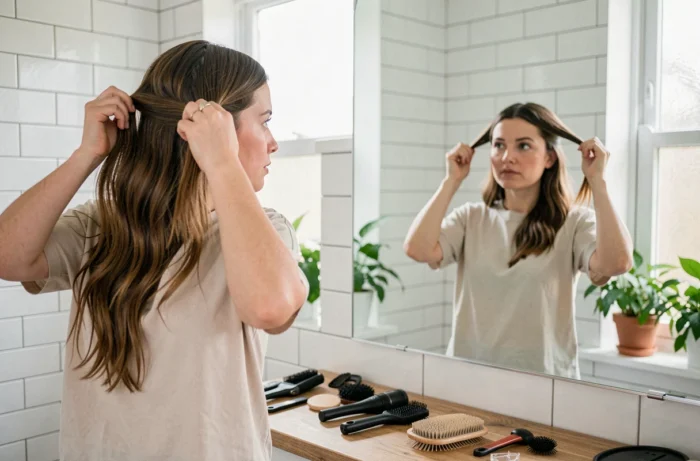
Actual Maintenance Time: A Choice Criterion Too Often Ignored
Lifestyle weighs as much as morphology in the choice of length. A cut that requires a daily blow-dry of twenty minutes is not suitable for someone who has five minutes in the morning.
Short cuts (pixie, boyish) require a visit to the salon every four to six weeks to maintain their shape. They are quick to style daily, but their salon maintenance is more frequent than for medium-length hair.
Long hair spaces out visits to the salon but requires regular care (masks, detangling, heat protection) to avoid looking dull or split-ended. The medium length remains the best compromise between cutting frequency and styling ease.
- Short cut: quick daily styling, frequent salon touch-ups
- Medium length (collarbone): versatile, moderate maintenance, compatible with a quick updo
- Long hair: fewer salon visits, but a heavier care routine
- Curly or frizzy hair: add time for natural drying and curl definition, regardless of length
Test Before Cutting: Simulators and Stylist Method
Cutting hair remains an irreversible action in the short term. Several methods allow you to visualize the result before taking the plunge.
Hairstyle simulation apps use a selfie to overlay different lengths and styles. The result remains approximate, especially on curly textures, but it provides a useful first indication to eliminate options that do not suit at all.
The most reliable method remains consulting with a stylist using reference photos. A professional assesses in real-time the texture, growth pattern, density, and cowlicks, parameters that an algorithm captures poorly. Bringing three to five photos of desired cuts allows the stylist to adapt the length to your hair reality.
Tracing the outline of your face on a mirror (drawing around your reflection with an erasable marker) also helps identify your facial morphology without measuring instruments. This simple technique reveals whether the face tends towards oval, round, or square, guiding the choice of length accordingly.
The hair length that works is one that takes into account both the shape of the face, the hair texture, and the time available for maintenance. No universal rule replaces the cross-analysis of these three criteria, ideally validated by a stylist who knows your hair type.