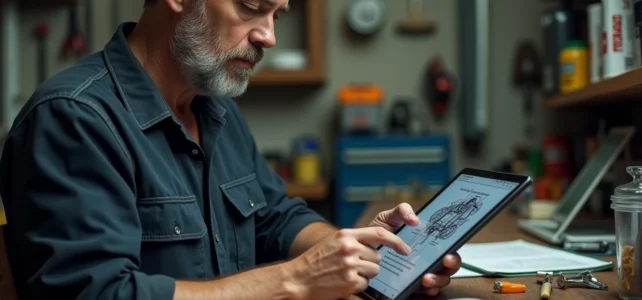
Are you looking to replace your brake pads or understand a check engine light, and the mechanic quotes a hefty estimate? Before making an appointment, a technical automotive review (TAR) in PDF could provide you with the necessary information to diagnose the issue or perform the maintenance yourself. The problem is that finding reliable, free, and legal documentation is not straightforward.
Manufacturer Manuals in PDF: The Legal Source That Few Drivers Utilize
Before searching on forums or dubious sites, there is a simple reflex to adopt. Car manufacturers are increasingly publishing their complete user manuals in PDF for free access directly on their official websites.
These documents cover part of the needs typically associated with a TAR: diagrams, basic maintenance procedures, technical specifications, descriptions of warning lights, and simple torque values. The owner’s manual for the CUPRA Ateca, for example, is freely downloadable from the brand’s official website and details the vehicle’s technical specifications as well as common maintenance operations.
Why is this option underutilized? Because these manuals do not carry the name “technical review.” They are titled “owner’s manual,” “user guide,” or “owner’s manual.” Type the name of your model followed by “manual PDF” on your manufacturer’s website, and you will often find a document of several hundred pages without spending a dime.
The limit is clear: a manufacturer manual does not replace a complete TAR. It generally does not contain advanced disassembly procedures, detailed mechanical breakdowns, or advanced engine adjustment values. For an oil filter change or battery replacement, it’s sufficient. For work on the timing system, you’ll need to go further.
Several methods exist to download a free technical automotive review in PDF by combining these manufacturer resources with other legal sources.

Free TAR in PDF: Distinguishing Legal Documentation from Counterfeits
Technical automotive reviews are works protected by copyright. Publishers like ETAI (which publishes TARs) or Haynes invest in writing these technical guides. Distributing their content in PDF without permission constitutes counterfeiting, even if the file circulates for free.
Have you ever seen links promising “free TAR PDF for all models” on forums or file hosting platforms? In most cases, these files pose two problems:
- They violate the intellectual property of the publisher, exposing the downloader to legal risks, even if prosecutions remain rare for individuals
- Files hosted on unofficial platforms frequently contain malware disguised as PDFs or redirect to phishing pages
- The quality of the scan is often poor: missing pages, unreadable diagrams, misnumbered pages, making workshop use unreliable
Inaccurate or incomplete technical documentation can lead to assembly errors. On a braking circuit or a steering system, the consequences go beyond mere inconvenience.
Specialized Sites for Automotive Technical Documentation
Several platforms offer automotive mechanical documentation within a legal framework, with varying levels of free access.
Community Platforms by Brand
Sites like VAG-Technique.fr focus technical documentation on a group of manufacturers (Volkswagen, Audi, Seat, Skoda). These community platforms gather maintenance sheets, tutorials, and sometimes excerpts of official documentation shared with the rights holders’ agreement.
The advantage of a brand-specific site is precision. Contributors know the specifics of each engine and each model generation. The content is often more up-to-date than a generic PDF.
Dedicated Mobile Applications
The “Automotive Technical Review” app available on Google Play offers access to technical documentation from a smartphone or tablet. This format presents an obvious practical interest: consulting a diagram directly under the hood without printing a PDF of several hundred pages.
Always check if access is truly free or freemium. Many apps display “free” but limit accessible content without a subscription to a few basic sheets.

Concrete Method to Find the Right Documentation for Your Vehicle
Rather than a generic search “free TAR PDF,” a targeted approach yields better results. Here are the steps that work:
- Precisely identify your model, its engine type, and its year of first registration (this information is on your registration document, boxes D.2 and D.2.1)
- First, search for the manufacturer manual on the brand’s official website, combining the model name with “owner’s manual PDF”
- Supplement with specialized forums for your brand, where members often share detailed maintenance sheets for common operations (oil changes, filter replacements, brake bleeding)
- For older vehicles, digital libraries and certain collector associations upload technical documentation that has entered the public domain or is shared with permission
This method requires a few extra minutes of research, but it produces reliable documentation tailored to your exact model, without the risk of viruses or legal issues.
The Case of Classic Cars
For a vehicle over twenty years old, the situation is often more favorable. Technical reviews of older models circulate more freely, some editions are no longer marketed, and enthusiast communities have digitized and shared a considerable amount of documentation. Car clubs are a valuable resource: membership (often modest) grants access to complete technical libraries.
Paper automotive technical documentation has not disappeared, and for complex interventions, investing in a paper TAR remains the safest choice. The price of a new book represents a fraction of the cost of an hour of labor in a garage. A free PDF may suffice for routine maintenance, but when it comes to removing a turbo or timing a distribution, the reliability of the document in your hands makes all the difference.