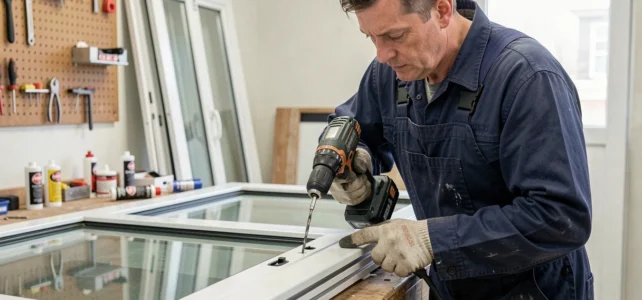
A double glazing that fogs up between its two panes is a sign that the peripheral seal has failed. The insulating gas (often argon) has escaped, the internal desiccant is saturated, and the thermal performance of the glazing has dropped.
The question often arises: can we reintroduce gas into double glazing without replacing everything? The short answer is no, not under the conditions of a typical construction site. Here we explain why, and especially what we do concretely when the problem arises.
Failed seal and loss of argon: what really happens in the glazing
The argon gas injected between the two panes during manufacturing does not remain trapped indefinitely. The European standard EN 1279-3 provides for a maximum allowable leakage rate, which means that insulating glazing naturally loses a small fraction of its gas each year, even with a compliant seal.
The problem occurs when this leakage accelerates. A shock, aging of the sealing mastic, repeated thermal expansion, or a spacer defect can cause a rupture of the peripheral seal. The argon then escapes faster, replaced by ambient air laden with moisture.
The phenomenon is identified by condensation between the panes: persistent fogging, droplets, and sometimes whitish streaks. At this stage, the desiccant (small absorbent beads housed in the spacer) is saturated. It can no longer capture the moisture that enters.
The idea of drilling the glazing to reinject gas and seal the hole circulates on forums. In practice, this operation poses several problems that professionals are well aware of. The standard procedure is to replace the entire insulating glazing unit, an intervention that can be better understood by exploring how to reintroduce gas into double glazing properly.
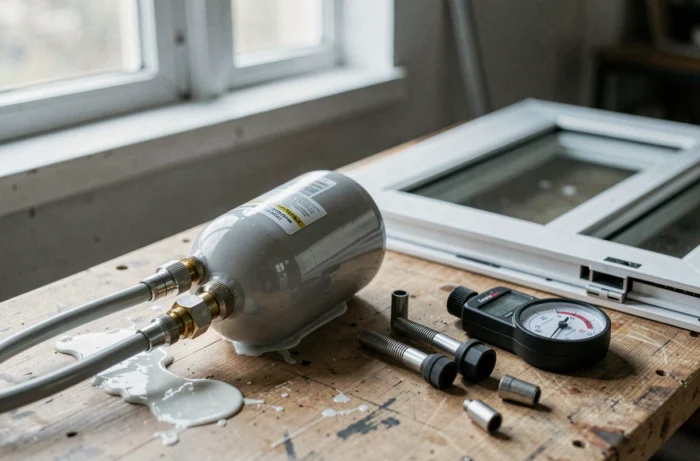
Recharging double glazing with argon gas: why it is not feasible on-site
In a factory, the filling with argon is done in a controlled environment. The cavity between the panes is purged, the gas is injected at a precise rate (generally the vast majority of the volume must be argon for the thermal gain to be significant), and then the glazing is immediately sealed with a double seal (butyl and polysulfide or structural silicone).
On already installed glazing, none of these conditions are met:
- Drilling the glass or the spacer mechanically weakens the glazing and creates an additional entry point for moisture, even if sealed.
- The original peripheral seal is already compromised, meaning that the reintroduced gas would leak again within weeks or months.
- There is no reliable means on-site to measure the achieved filling rate or to guarantee the absence of residual air in the gap.
An insulating glazing unit is a factory-sealed unit, designed not to be opened or recharged. It is this original sealing that determines the entire lifespan of the product.
The case of “defogging” kits sold online
Kits promising to drill the glazing, dry the interior, and seal it are available. These solutions address the symptom (the fogging) without restoring the gas or the seal’s integrity. Moisture typically returns after a few months. The thermal gain remains zero since air replaces the argon and the seal is not redone.
Replacing the insulating glazing without changing the window frame
The good news is that it is not necessary to replace the entire window. On most wooden, PVC, or aluminum frames, only the insulating glazing (the IGU) is replaced. The frame and the opening remain in place.
The operation follows a precise sequence:
- Removal of the stop beads (the profiles that hold the glazing in the opening), using a stop bead cutter or a spatula suitable for the frame material.
- Extraction of the faulty insulating glazing, noting the exact thickness of the gap (distance between the two panes) and the type of original gas if the label on the glazing is still legible.
- Ordering a new insulating glazing unit to the measured dimensions, filled with argon and, if possible, a “warm edge” spacer to limit thermal bridging at the perimeter.
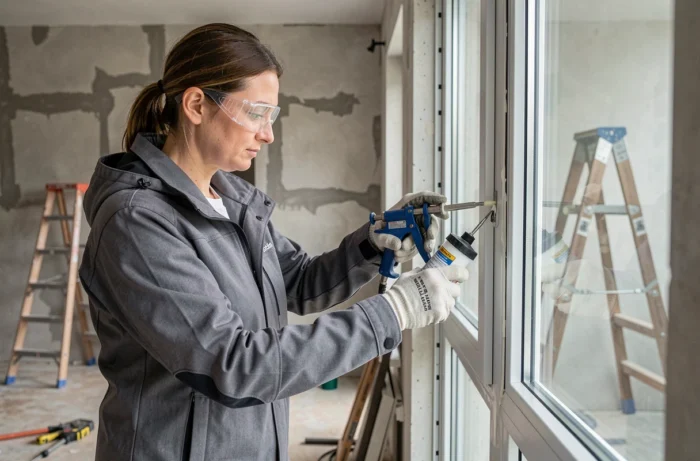
- Installation of the new glazing with correct shimming (support and play shims), then reinstallation of the stop beads.
For a wooden window, the DTU 39 governs the implementation. It is checked that the rebate is sound, that the joint backing is clean, and that the drainage of the glazing works (the water drainage holes at the bottom of the rebate must not be blocked).
Thermal insulation after replacement: what the new glazing really changes
Transitioning from glazing with escaped gas to new glazing filled with argon significantly improves the Ug coefficient (thermal transmission of the glazing alone). Argon, being denser than air, slows convection in the gap and reduces heat transfer.
The gain also depends on the low-emissivity coating applied to one of the inner faces of the glazing. This treatment reflects part of the infrared radiation back into the living space. It is the combination of argon and low-emissivity layer that produces most of the thermal gain, not the gas alone.
Should krypton be considered?
Krypton offers even lower thermal conductivity than argon. It becomes relevant when the available thickness for the gas gap is reduced (as in some older frames with narrow rebates). Its cost is significantly higher, and feedback varies on the relationship between the additional cost and the actual gain in Ug on standard double glazing.
For the majority of window renovations, argon remains the most coherent choice between performance and budget.
An insulating glazing unit that shows fogging between its panes has lost its sealing and gas. Rather than seeking a complete replacement of the glazing unit, replacement within the existing frame restores thermal insulation at a cost much lower than changing the entire window.
The point to check before any order: the condition of the frame, the rebate, and the drainage system. A new glazing unit installed on a degraded support will reproduce the same problem within a few years.