
The advertising posters visible in JCDecaux bus shelters are replaced on a regular cycle. Once the advertising campaign is over, field agents remove the visuals to install the next ones. These large-format posters, often printed with careful colors on dense paper, are then sent for destruction. Recovering these visuals before they end up in a landfill requires understanding the precise workings of this replacement process and adopting the right approach with the teams in the field.
Ownership of Posters and Legal Framework of Urban Furniture
The urban furniture type bus shelters are leased by local authorities to operators like JCDecaux through concession contracts. The entire setup (panel, structure, showcase) belongs to the operator or the municipality depending on the contract clauses. The posters themselves remain the property of the advertiser or the advertising network until they are removed.
In practical terms, tearing down or dismantling a poster still in place on a bus shelter constitutes damage to urban furniture. Several municipalities, like Montpellier in recent years, have tightened their policies against damage to advertising furniture, including unauthorized attempts to recover items from leased devices.
The only legal way is to request the poster directly from JCDecaux agents at the time of replacement. Once removed from the panel, the poster no longer holds commercial value for the operator. The agents are then free to give it away, and several guides offer tips for recovering JCDecaux posters by adopting this direct method.
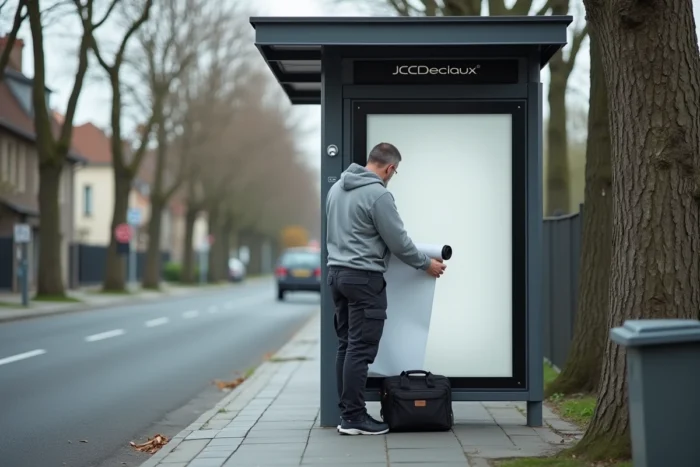
Replacement Schedule for JCDecaux Bus Shelter Posters
JCDecaux France has publicly confirmed on social media that poster replacements occur on Wednesday and Thursday mornings, between 4 AM and 2 PM. This time slot corresponds to the agents’ rounds at various bus shelters in a geographical area.
Each advertising campaign lasts one to two weeks depending on the contract between the advertiser and JCDecaux. The replacement thus follows a predictable weekly rhythm. Observing the bus shelters near you for a few days is enough to identify the exact day agents visit your neighborhood.
Identifying the Right Time Slot Locally
The agents do not operate on the same schedule everywhere. The rounds cover several dozen panels per team, meaning that the time of passage at a given bus shelter varies based on its position in the circuit. A bus shelter located in the city center will be serviced at a different time than one on the outskirts.
- Note the day when the poster changes at the bus shelter you are targeting, then return the following week at the same time to watch for the agents
- Prefer time slots early in the morning (between 5 AM and 8 AM), as most rounds start before the rush of public transport
- Identify the utility vehicle parked near the bus shelter: this is a sign that a replacement is underway
Requesting a Poster from Field Agents
The process is simpler than one might think. The agents give away removed posters upon simple request, as JCDecaux has publicly indicated. The poster left behind is no longer useful to the operator or the advertiser. It would otherwise be destroyed.
A few precautions can maximize your chances of leaving with the desired visual.
Adapting Your Request to the Context
The agents manage tight schedules. Arriving with a clear and precise request facilitates the exchange. Specify which poster you are interested in if multiple campaigns are being replaced. Offer to take the poster folded or rolled to avoid slowing down their work.
If you are targeting a specific campaign (a movie visual, a festival poster, an event communication), first identify which bus shelter it is installed on before the replacement day. Not all panels in the same neighborhood display the same campaign.
Formats and Display Media: What Can Be Recovered and What Cannot
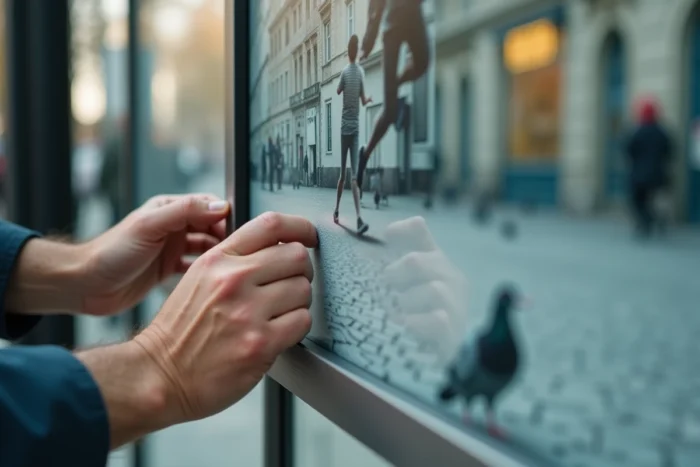
JCDecaux bus shelters primarily use the 120 x 176 cm format. This standard format produces posters large enough to serve as wall decoration or creative support.
Not all types of urban furniture lend themselves well to recovery.
- The classic bus shelters with fixed showcases are the most accessible: the agent opens the panel, removes the poster manually, and replaces it
- Rolling panels (rotating models with multiple posters in a loop) operate differently. The internal mechanism makes individual removal more complex, and agents do not systematically dismantle each visual
- Illuminated totems (double-sided panels on a stand) sometimes use backlit supports with specific translucent paper, which is more fragile and less suited for decorative use
The paper used for standard bus shelter posters has a sufficiently dense weight to withstand handling. These posters can be stored flat or rolled in a cardboard tube.
Valuation and Preservation of a Recovered Poster
A recovered advertising campaign poster in good condition can serve as raw decoration, framed, or mounted. Some posters from brands or movies become sought-after collector’s items in vintage markets and resale platforms.
Associations dedicated to preserving urban heritage sometimes organize recovery operations for old panels or display elements, in connection with local authorities, when JCDecaux furniture is removed or replaced. These para-official circuits offer an alternative to obtain rarer pieces than current campaigns.
To preserve the poster over time, avoid direct sunlight exposure, which quickly degrades print colors. Framing under glass with a neutral mat protects the visual and highlights the imposing format of these posters designed to capture attention from a distance.