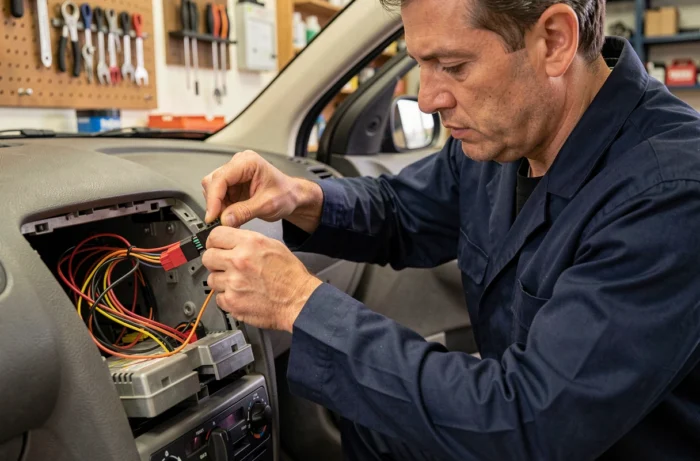
You just retrieved a new car radio for your Peugeot 206, you take it out of its box, and faced with the bundle of multicolored wires hanging behind the front panel, you hesitate. Each wire has a specific role, and reversing two of them is enough to blow a speaker or lose the memory of the unit every time the ignition is turned off.
This guide details the specific wiring for the 206, common pitfalls regarding power supply, and the method to retain the steering wheel controls after replacing the original unit.
Permanent wire and after-contact wire on the Peugeot 206: the classic confusion
On most vehicles, the yellow wire provides permanent power (memory, clock) and the red wire supplies power after contact. The 206 adheres to this convention on the car radio side, but the original Peugeot harness uses its own colors on the vehicle side.
The most common issue, described on several forums dedicated to the 206, concerns a unit that resets every time the ignition is turned off. This means that the permanent wire is not properly connected to the +12V battery source. A multimeter placed between the suspect wire and a reliable ground (door hinge, body screw) allows you to check for voltage presence with the ignition off.
If you identify a large permanent red wire and a yellow-green wire that remains at zero volts with the engine off, the original wiring has likely been modified or the dedicated fuse (often fuse 24 on the 206) is poorly seated. Before any intervention, check this fuse in the cabin fuse box.
To have a reliable car radio wiring diagram with wire colors for Peugeot 206, it is better to refer to a document that outlines the exact correspondence between the PSA connector and the standardized ISO connector, wire by wire.
ISO PSA adapter: signals to identify before connecting
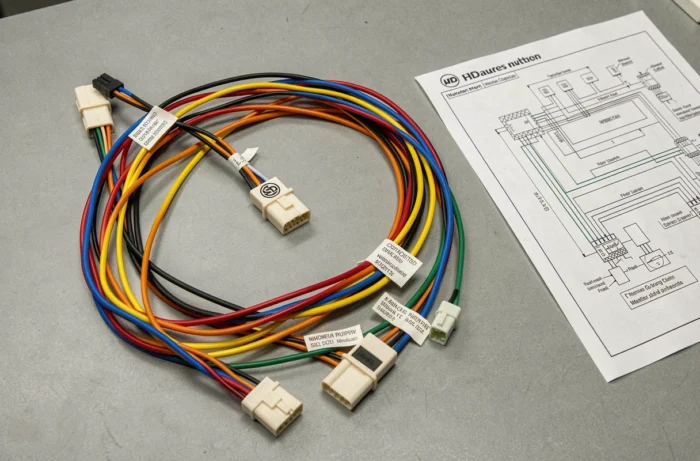
Why use an ISO adapter instead of connecting the wires directly? Because the Peugeot connector does not follow the universal ISO pinout. A dedicated PSA adapter translates each signal from the vehicle harness to the ISO plug of the car radio, without cutting or soldering.
Recent adapter plugs distinguish several distinct power lines:
- +12V permanent: maintains the memory of the unit (stations, settings, clock) even when the ignition is off.
- +12V after-contact (ACC): powers the unit only when the key is in the accessory or ignition position.
- +12V lighting: allows the backlighting of the car radio to follow the vehicle’s lights being turned on.
- +12V remote antenna: sends a signal to an external amplifier or motorized antenna to activate it when the unit is turned on.
- Ground (black wire): returns to the chassis, to be fixed to a clean and stable ground point.
Connecting the permanent wire and the after-contact wire together (yellow and red connected to the same source) makes the unit work, but the battery slowly discharges if the unit remains powered continuously without interruption from the ignition. This mistake is one of the most common on 206 models equipped with an aftermarket car radio.
Connecting the speakers of the Peugeot 206: identifying the pairs
Each speaker is connected by a pair of wires: one positive and one negative. Reversing the polarity on a speaker does not immediately destroy it, but causes a phase opposition. The sound then appears hollow, lacking bass, as if the speakers were working against each other.
ISO color convention for audio wires
The standard ISO pinout assigns a color to each speaker, with a solid wire for positive and a striped wire for negative:
| Location | Positive wire | Negative wire |
|---|---|---|
| Front left | White | White/black |
| Front right | Gray | Gray/black |
| Rear left | Green | Green/black |
| Rear right | Purple | Purple/black |
On the 206, the colors on the vehicle side differ. The ISO PSA adapter makes the correspondence. If you wire without an adapter, a multimeter in continuity mode helps identify each pair by sending a signal from the connector to the speaker.
Steering wheel controls of the 206: keeping control after changing the unit
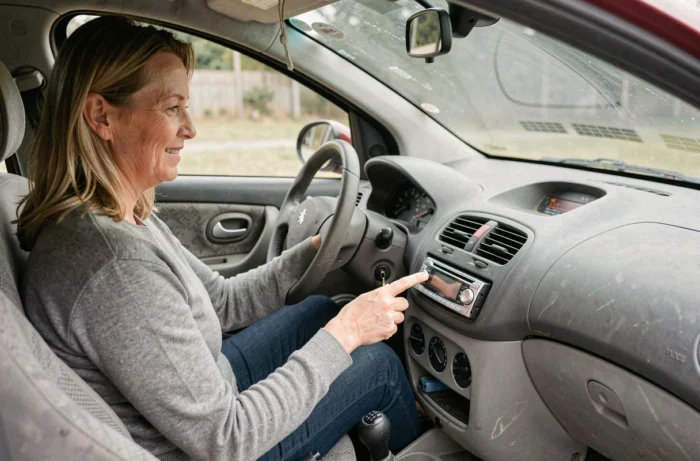
Do you use the volume and source buttons on the steering wheel with the original unit? These controls will not automatically work with a replacement car radio. The original Peugeot unit communicates directly with the ECU via a proprietary protocol. An aftermarket car radio does not understand this language without assistance.
Interface box or manual learning
Two solutions exist depending on the type of car radio installed. On recent Android units, manual learning is often possible in the settings: each steering wheel button is associated with a function (volume +, volume -, source, mute) by pressing each button successively during the setup procedure.
This method works on vehicles that do not use the CAN protocol for steering wheel controls, which is the case for many 206 models. If the vehicle communicates via CAN, a dedicated CANbus interface box is necessary to convert the signals.
In case of malfunction after installation (car radio not starting, controls inoperative), the first check concerns the B+ and ACC power supply of the interface box. Disconnecting and reconnecting the CANbus box often resets the communication between the steering wheel and the unit.
Checks after installation: points to verify before closing up
Once all the wires are connected, a few quick checks can prevent having to dismantle everything a week later:
- Test each speaker individually via the balance and fader of the car radio. A silent speaker indicates a poorly connected pair of wires.
- Turn off the ignition, wait a minute, then turn the ignition back on: the unit should return to the current station and previous settings. If not, the permanent wire is problematic.
- Check that the low beam headlights activate the dimmed backlighting of the unit (lighting wire).
- Test each steering wheel button if an interface box or learning has been configured.
A neat installation on the 206 does not require advanced electronics skills. Most errors come from a mix-up between permanent and after-contact, or from an absent ISO adapter. With the right harness and a multimeter to clear doubts, replacing the car radio remains accessible to a methodical DIYer.